
I wonder sometimes if the reason people have relationship problems is simpler than we make it. Relationships change people. And a lot of people are not willing to be changed.
That’s it. Not communication styles, not love languages, not whether you squeeze the toothpaste from the middle. Those are symptoms. Underneath most of them is a person who walked into a relationship with a picture of who they were and how life was supposed to go, and who is now fighting to keep that picture intact while the relationship quietly redraws it.
I don’t think this is about age, either. I’ve known people who married at 20 and stayed rigid, and people who married at 45 and bent like willow. The problem is having definite ideas about what life should be without ever realizing that we don’t get much choice in what gets presented to us. Life hands us what it hands us. The only real choice is how we respond to it, and who we respond to it with.
Why we fight it
So why do people resist being changed by the person they chose? I think it’s a mixture of pride and fear, and they feed each other.
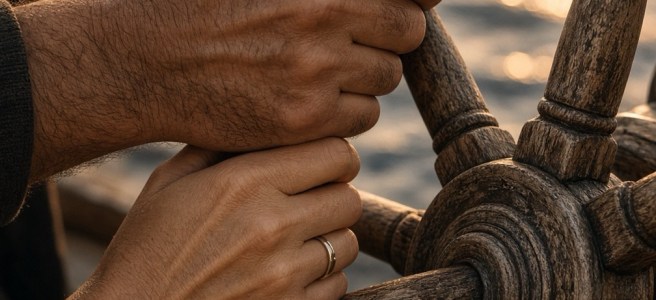
The pride is in the self-image. You’ve spent years building an idea of who you are and where you’re taking this life. You’re the captain. You know the heading. Then someone climbs aboard who matters to you, and suddenly every course correction has to pass through a second set of hands on the wheel.
The fear is the quieter one. You’ve grown attached to this person. You love them. And somewhere in you is the knowledge that loving them means they get a say, and that a say means you are no longer fully in control of who you become. That is a frightening thing to admit, so most of us don’t. We just dig in.
Here’s the part the vows say and most of us skim. We don’t get to be dictators in a relationship. We have to be servants.
That sounds like a loss, and in one sense it is. But a dictator only ever gets what one person can imagine. A servant, strangely, ends up with more. He’s building something he couldn’t have built alone, and he’s being built by it at the same time.
The people who struggle most, I think, are the ones who want the love without the service. They’re still in love. But every choice they’d make for themselves now has to be filtered through another person who may want something different. And instead of working together to mold shared desires, they keep two separate lists and resent every line that doesn’t match.
The dreamer who got married at 20
I can say all this because I was the dreamer.
My wife and I got married at 20. I was a junior in college, she was a sophomore, and neither of us had any real direction about what we wanted to do with our lives. She had more than me. She wanted to be a wife and mother. Me? I was a music performance major with vague thoughts of teaching high school music, which I’ve since figured out I would have hated. I had no drive to get out into the world and make anything of myself. The only marker I had was that I wanted to be “successful,” whatever that meant.
What we did know was that we wanted to be married to each other and build a life together. That was the whole plan. And looking back, I think that was exactly the right amount of plan. Because we hadn’t set yet, we could be fluid about direction, about who we were going to become, about what our shared goals even were. We got shaped together instead of having to reshape two finished people.
And marriage shaped me fast. The moment I realized it wasn’t just my survival on the line anymore, that the survival of the marriage, of the couple, of my best friend depended on me too, I became responsible in a way I never had been. My goals stopped being me goals and became us goals. It made me better.
What it cost
It wasn’t painless.
What I gave up was a future of complete autonomy. Not a hobby, not a career path. The thing itself. Being married means it is now our journey and not my journey, and every choice I might want to make has to pass through another person first. Every single one. Where we live, what I chase, how I spend a Saturday, what I say yes to and what I let go of.
And it only works if it runs both directions. If one person is doing all the bending, that isn’t two servants. That’s a dictator with a very cooperative staff.
That filter is the exact spot where I watch people get hung up. They’re still in love. They just can’t stomach it. They want the life they pictured, with this person standing in it, and they never quite accept that the picture itself has to be redrawn by two sets of hands.
Here’s what I’ve come to believe after twenty-eight years together: the autonomy was never real anyway.
Autonomy to oneself leads to loneliness. It leads to a general lack of purpose. You get to make every decision and answer to nobody, and what you find at the end of that road is a man standing by himself, wondering what the point was.
I look at my life now and the roles I get to serve in. Husband. Father. Best friend. I would never have known I was missing them. You can’t miss what you’ve never held. But standing on the other side, I can tell you they are the most valuable things in my life, and not one of them was available to the version of me who kept full control.
In giving up the me for the we, I gained so much more than I gave.
The admission that fixes most of it is a hard one: this is no longer about me. That was the vow. Not that I would stay the same and be loved anyway, but that I would let myself be reshaped by the person I promised to serve.
I’m not trying to become a better version of me. I’m trying to become us. And that, it turns out, is the better version.


