Day 59: Point Toward the Horizon

I was reading Donald Miller today — A Million Miles in a Thousand Years — and he tells the story of a friend who runs a law firm. Not just any law firm. This firm rescues girls from human trafficking and the sex slave trade.

When Miller asked the man what his primary job was, the answer wasn’t legal strategy or fundraising or case management. The man said his job was to show up every morning and remind his lawyers what their mission was. To point them toward the horizon of saving the powerless.

That’s it. That’s the job. Point toward the horizon.

I’ve been thinking about that all day. Because I think most of us wake up and start working without ever looking up. We open the laptop. We check the list. We push the cart forward. But we never stop to ask — forward toward what?

A ship without a horizon is just a floating room.

I spent twenty years with notebooks full of goals and no horizon to aim them at. I had tools. I had ideas. I had desire. What I didn’t have was a clear picture of where all of it was supposed to go. So the tools just sat there, and the ideas piled up, and the desire burned slow and quiet and never caught fire.

December 2025, I finally pointed at something. I wrote a document. I named the habits. I set the course. And sixty days later, everything that felt like wasted time has started to look like foundation.

The horizon doesn’t have to be perfect. It just has to be visible. And the first step toward seeing it clearly is being willing to ask: where am I actually trying to go?

Day 59. Eyes up.

I write every day about transformation, habits, and what actually happens when you stop planning and start doing. If that resonates, join the list at subscribepage.io/5g8Hdy and I’ll send you one email per week with the best of what I’m learning.

Day 57: A Character Is What He Does

Round 2, Day 17
Tuesday, March 3, 2026


I remember hearing Randy Travis for the first time when I was in the fifth or sixth grade. Late ‘80s. This was right after he’d gotten big — Forever and Ever, Amen was everywhere. But when you grew up the way I did, you didn’t just hear the singles. You got the whole album. You listened to every track. And you picked up songs that most people never heard because they only listened to the radio.

There’s a song on that same album called “Good Intentions” — and I can still sing the chorus almost 40 years later:

I hear tell that the road to hell is paved with good intentions. Well, Mama, my intentions were the best. There’s lots of things in my life I’d just as soon not mention. Looks like I turned out like all the rest. But Mama, my intentions were the best.

That chorus came back to me today during my reading.


I’m still working through Donald Miller’s A Million Miles in a Thousand Years, and he’s unpacking what he learned turning his memoir into a movie script. The screenwriters and story experts taught him something that sounds simple but cuts deep:

A character is not what he says. A character is not what he thinks. A character is what he does.

Think about every book you’ve loved. Every movie that stayed with you. The characters that endure aren’t the ones who talk big. They’re the ones who act. We don’t remember them for their speeches. We remember them for their choices.

If you’ve read the Harry Potter books, you know exactly what I’m talking about. Severus Snape, judged by what he said and how he appeared, was a villain. Cold, cruel, seemingly loyal to the enemy. But when you see the full arc — what he actually did — he’s the hero of the entire story. He was a mole inside enemy territory for over a decade, driven by love for a woman he could never have, protecting her son even though that son reminded him of the man he hated most. Strip away what Snape said. Look at what Snape did. He was one of the bravest characters in the story.


Miller’s point isn’t just about screenwriting. It’s about how we live.

Are we the character who talks about what we’re going to do? Or are we the character who does it?

I spent years saying I wanted to be a writer. I told people I was going to write a book. I had notebooks full of ideas going back twenty years. But I wasn’t a writer. Not really. I became a writer when I sat down and actually wrote the book. The doing made it real. The wanting never did.

I can say I want to be a good husband. I can say it every day. But until I actually love my wife and put her needs above my own — consistently, not just when it’s convenient — am I really a good husband? Or am I just a guy with good intentions?

Randy Travis had it right. The road to hell is paved with them.


This is why the 7-40 Challenge matters to me. It’s not about the checklist. It’s about becoming the character who does the thing instead of the character who talks about the thing.

Fifty-seven days in, I haven’t missed one. Not because I’m special. Because I decided that the gap between what I say and what I do needed to close. And the only way to close it is to do it. Every single day.

So I have to ask myself — and I’m asking you too: What is the character you want to play in your life? Are you doing the thing, or just talking about the thing?

Because a character is what he does. And good intentions don’t count.


Day 57 — Seven for Seven

See you tomorrow for Day 58.

Day 56: The Hero Can’t Be the Loser

Round 2, Day 16
Monday, March 2, 2026


I’m rereading Donald Miller’s A Million Miles in a Thousand Years, and he tells a story that I can’t stop thinking about.

A friend of his had a daughter who’d started dating a bad kid and smoking pot. Miller, fresh from Robert McKee’s story workshop, said something that sounds simple but lands like a hammer: “She’s stuck in a bad story.”

His friend didn’t get it at first. But Miller explained the framework he’d learned — a story is a character who wants something and overcomes conflict to get it. And this friend realized something uncomfortable: he wasn’t presenting a very engaging story for his family. There was no mission, no purpose, nothing bigger than the routine. So his daughter went looking for meaning somewhere else — and she found it in a boy who wasn’t treating her well. At least he was telling her a story where she mattered.

The friend signed up to raise $25,000 to build an orphanage in Mexico. He didn’t have $25,000. His wife was shocked. His daughter was skeptical. But the whole family ended up rallying around it — and here’s the punchline that Miller drops:

“A girl who’s acting in the role of the hero can’t be in a relationship with a loser.”

It just doesn’t work. Because when you find meaning in your own story, when you know your own worth, you can’t lower yourself to be treated poorly. The bad relationship couldn’t survive the better story.


I’ve been thinking about how this applies to what I’m building.

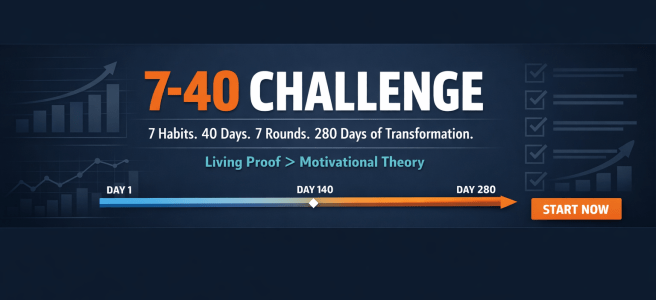
The 7-40 Challenge is, at its core, a decision to tell a better story. Seven habits, every day, for 280 days. Not because checking boxes changes your life — but because the discipline of showing up daily puts you in a different role. You stop being the person things happen to. You start being the person who makes things happen.

And here’s what I’m discovering 56 days in: when you start playing the hero in your own story, it gets really hard to involve yourself in the things where you’re the loser.

The junk food that used to be easy to justify? Harder to eat when you’ve tracked your calories for eight straight weeks and watched the scale move 13 pounds. The excuse to skip a workout? Harder to make when you’ve got 56 days of unbroken execution behind you. The temptation to play it small, to hide, to keep your ideas in a drawer? Harder to give in to when you’ve written 56 blog posts, worked on two novels, lost 13 pounds and have the realization that you’re just getting started.

The better story crowds out the worse one. Not because you become perfect — but because you become aware. You see the choice for what it is. And once you see it, you can’t unsee it.


Miller’s friend didn’t rescue his daughter by lecturing her. He didn’t ground her or take her phone away. He gave the family a mission. He gave them a story worth living. The daughter rescued herself — because the better story made the bad one impossible to tolerate.

I wrote recently about what it feels like to drift through life without a plan. I compared it to floating face down in water, only lifting your head from time to time to see where the current has taken you. That’s how most people live — pulled by the tide, reacting instead of choosing, going wherever the flow sends them.

To live differently, you have to put your feet down. You have to stand up and let the current run around you. And then you have to decide which direction you’re going to walk.

Nobody’s coming to make this easier. There’s no rich relative showing up with a check. No lottery win. No miraculous rescue. You either tell the story or somebody else tells it for you — and you’re just a character in theirs.


I’m 56 days into telling my own story. It’s connected to everything — my work, my family, my health, my writing, my faith. I can’t compartmentalize it anymore. I have to be the same person at work that I am at home. I have to give the same effort to the things I love that I give to the things I’m paid to do. Because all of it is part of the legacy I leave behind. All of it is part of the story I choose to tell.

If I start to play the hero, it’s really hard to involve myself in things where I’m the loser.

And those are my thoughts for today.


Day 56 — Seven for Seven

See you tomorrow for Day 57.

The Family You Choose

Day 55 — Gratitude Sunday

March 1, 2026

Today I am thankful.

I’m thankful because I have friends. Two friends, specifically, who over the years have become not just friends — but family. Chosen family. The kind that is just as close as blood.

Last night we went to dinner at Whiskey Cake, a really cool eatery in Oklahoma City that serves freshly prepared, locally sourced food. The K’s sat across the table from us, and we talked about everyday things — family, activities, what everyone’s been up to. And all of that was wonderful in itself. But as I sat there and listened, I had to soak in just how good and right all of it felt.

These are the people who have been there through the hard times. These are the people we know we can count on, depend on, trust. These are friendships that started when we were barely twenty years old and have lasted almost three decades. And they’ll last from here.

You don’t get this kind of depth without taking years of time to just be friends.

There have been seasons where we didn’t get to see each other as much as we wanted. We were in Texas for nine of those years, and it made things tough. But we stayed dedicated — visiting several times a year, driving back and forth, staying in each other’s homes. One of their daughters even mentioned that she loved having us back in town, but that she missed us living in the DFW area because they didn’t get to go on road trips like they used to. That made me smile, because even in the distance, we had built something that was enjoyable. Something worth driving to.

It’s the process of getting to be with people you’re this close to. Just to share in their life. To know that you’re part of their story and they’re part of yours. To see their successes. To be there when they hurt. I love every bit of it. I love having these kinds of friendships because I know they are rare.

In today’s world, you don’t find this just anywhere. You can’t rush it. You can’t manufacture it. You build it one dinner, one visit, one road trip, one hard conversation at a time — over years and years and years.

The Bible says there is a friend who sticks closer than a brother. It’s true. That’s what the K’s have been to us. Not just friends. Family. Not by blood by choice.

So thankful for you.

Rest Is Not Retreat

Day 53 — The 7-40 Challenge

February 27, 2026

I didn’t work out today. And I’m fine with it.

Yesterday I spent 95 minutes in the gym and burned 1,400 calories according to my Apple Watch. Tomorrow morning I’ll be outside for several hours finishing a garden project for my wife — hauling materials, drilling, bending, lifting, sweating in the Oklahoma air. That’s not a light day. That’s manual labor.

So today, I rested. On purpose.

There’s a difference between rest and retreat. Retreat is what happens when resistance wins. It’s the moment you close the laptop, skip the creative hour, and tell yourself none of this matters anyway. Retreat is reactive. It comes from a place of defeat.

Rest is strategic. It comes from a place of awareness. I know what I did yesterday. I know what’s coming tomorrow. And I know that running myself into the ground today doesn’t make me tougher — it makes me less effective when it actually counts.

Here’s the thing most people miss about discipline and habit streaks: rigidity is not the same as consistency. If your system can’t absorb a rest day without collapsing, your system is brittle. And brittle things break.

When I built the 7-40 Challenge, I wrote into my vision document that there would be times when exercise needed to look different. Not optional. Not a loophole. A stipulation. I decided before the moment arrived that strategic rest would be part of the plan — not a violation of it.

That matters more than it sounds like it does. Because when today came, I didn’t have to negotiate with myself. I didn’t have to justify it or feel guilty about it. The decision was already made. I just executed it.

That’s the same principle I wrote about yesterday — responding versus reacting. A response flows from something pre-programmed inside you. If you plan your rest, it’s a response. If you skip because you’re tired and feel bad about it, that’s a reaction.

Fifty-three days in, I’ve learned that the streak isn’t the point. The system is the point. The streak serves the system. The system doesn’t serve the streak. And a system that accounts for the reality of a human body — one that lifted heavy yesterday and will work in the yard tomorrow — is a system that lasts 280 days and beyond.

So if you’re someone who beats yourself up every time you take a day off, I’d ask you this: did you plan it, or did it just happen? If you planned it, that’s not weakness. That’s energy management. That’s wisdom. That’s the kind of discipline that doesn’t make the highlight reel but keeps you in the game long enough to finish what you started.

Rest is not retreat. Not when it’s strategic. Not when tomorrow’s already on the calendar.

Day 53. Resting on purpose. Back to work in the morning.