Day 47: The War Inside Your Head

Round 2, Day 7
Saturday, February 21, 2026

There’s a war going on inside your head right now, and you probably don’t even know it.

Seth Godin, in his book Linchpin, calls one side the lizard brain. Steven Pressfield, in The War of Art, calls it the Resistance. It’s the part of your brain that exists for one purpose: to keep you safe. And it’s very, very good at its job.

The other side? The ancient Greeks called it the Daemon. The Romans called it the Genius. It’s the creative force inside you — the part that sees possibilities, generates ideas, and pushes you toward something greater than survival.

And these two are at war with each other every single day.

The Idea You Let Die

Have you ever had a really good idea? Something creative, something that could help people, maybe even a business concept that excited you? And then a voice in your head said, “Nah. That’s too risky. That’ll never work.”

So you let it go.

And then, a year or two later, you saw that exact idea out in the world — built by someone else. And you thought, “That was mine.”

Godin would say that was your Genius, getting strangled by your lizard brain. And it happens all the time. Not because we lack ideas. Not because we lack talent. But because our biology is wired to treat creativity as a threat.

Why We’re Wired This Way

Here’s the part that hit me. Godin points out that the lizard brain loves being told what to do. Following instructions feels safe. If someone hands you a rulebook — sit here, do this, move to the next step — your lizard brain relaxes. Threat neutralized. Everything is fine.

But if you’ve ever been fired from a job without ever having a bad performance review, you know that following instructions doesn’t guarantee safety. You can do everything you’re asked to do — take care of people, excel at your work, check every box — and still get let go. I’m a firm believer that people like this end up finding better jobs, but that’s a post for a different day. The point is: compliance is not security. The only set of instructions I’ve ever found that truly delivers on that promise is God’s Word. But when humans are running the show, the rulebook can change on you overnight.

So why do we cling to it? Because we were trained to.

Think about it. From the time we were children, we were conditioned: sit down, shut up, learn the lesson, do the homework, move to the next grade. Year after year after year. Over a decade of training that rewarded compliance and punished deviation.

Is it any wonder we struggle to engage with our Genius as adults? We’ve spent our entire lives being told that coloring inside the lines is the path to success. And then we hit thirty, forty, fifty years old and wonder why we can’t create anything.

We have years of conditioning to overcome. That’s not an excuse — it’s just the reality of the battlefield.

Give the Lizard Brain a Roadmap

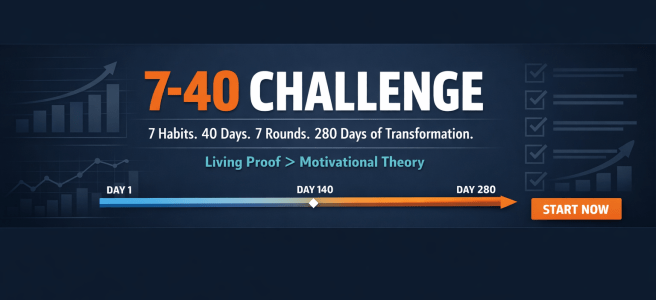
Here’s where it gets practical, and this is where the 7-40 Challenge connects.

The lizard brain needs structure to feel safe. The Genius needs freedom to create. So what if you gave the lizard brain what it wants — a roadmap, a set of daily habits, a predictable rhythm — so that the Genius can do its work without triggering a full-scale panic?

That’s exactly what these seven daily habits do for me.

The Bible study grounds me. The exercise clears my head. The water and calories keep my body functioning. The reading fills the creative tank. And by the time I get to my creative hour, the lizard brain has been fed. It’s calm. It’s satisfied. And the Genius shows up.

In the last forty-seven days, the Genius has been showing up. If you read yesterday’s post, you know the list of what’s been accomplished. And today alone, I’m getting my first book uploaded to KDP and I outlined a full two-act musical that’s been rattling around in my head for four years. That’s not because I defeated the lizard brain. It’s because I gave it a structure it could trust, and then I created within that structure.

The Real Question

So it comes down to this: Is it worth it?

Is it worth it to engage your life, work out the steps, build the habits, and push through the Resistance? Or do you sit in the job you hate, accept somebody else’s direction, and spend your life as a member of the factory?

Gary Vaynerchuk said something that stuck with me: “If it was supposed to be easy, everyone would do it.” And that makes sense, because everything worth doing requires us to fight our natural desire to stay safe in order to succeed.

I choose succeeding. I choose making myself better and honoring God by doing the most with the talents He gave me. Because I refuse to be the servant in Jesus’s parable who buried his talent in the ground because he was afraid to use it. That servant didn’t get praised for playing it safe. He got cast away.

The lizard brain says bury the talent. The Genius says invest it. The choice is yours — every single day.

I know which one I’m choosing.


Day 47 of 280. Feed the lizard. Free the Genius.

Day 43: The Factory Worker Inside You

Round 2, Day 3
Tuesday, February 17, 2026

I’m still working through Seth Godin’s Linchpin, and tonight I want to talk about something that might make you uncomfortable.

There’s a factory worker living inside you. And if you’re not careful, he’ll run the show.

The System That Built Us

Godin makes the case — and he wrote this back in 2010 — that the industrial revolution didn’t just build factories. It built an education system designed to feed them. Sit down. Follow instructions. Get good grades. Go to college. Get a job. Do what you’re told. Collect a paycheck.

The highest value of that system wasn’t innovation. It wasn’t creativity. It was compliance. The goal was to produce people who could do a job for a day’s wage and not have to think.

And for a long time, that system worked. For the factories, anyway.

But here’s the thing Godin saw coming sixteen years ago: that era is over. And if it was over in 2010, it is buried in 2026. The rise of AI, the speed of change in the marketplace, the sheer volume of information and tools available — all of it demands something the factory model never taught us.

Applied creativity.

The Moment You Start Phoning It In

I know the factory worker mindset from the inside. During my days working in an insurance office, I felt it pulling at me constantly. When your contribution doesn’t seem to matter, when you’re not making progress, when the environment is draining — it is incredibly easy to just phone it in. Go through the motions. Clock in, clock out, repeat.

I think we all have moments like that. Seasons where the path of least resistance is to stop caring and just do the minimum.

I started breaking out of it when I realized something simple but powerful: my level of effort actually moved the needle. When I brought energy and intention to my work, things changed. When I phoned it in, they didn’t. The results were directly connected to the investment.

That’s not a complicated idea. But it’s one most people ignore.

The Rogue in the Cubicle

Here’s what I’ve learned about myself over the years. I am a creative free spirit living in a corporate, data-ordered world. Those two things don’t always get along.

I have to turn on music to keep my brain engaged. I have to move. I have to conceptualize problems in different ways just to stay satisfied — not because I’m difficult, but because that’s how I’m wired. And honestly, that creative wiring is exactly what makes me good at what I do.

Because if we look at things the same way every time, we never solve problems. We just keep describing them. New solutions require new ideas, and new ideas come from people who refuse to think inside the factory lines.

That rebellious streak? It’s not a flaw. It’s the linchpin quality Godin is talking about.

AI and the New Frontier

This is even more real for me right now as I learn to work with AI tools. The way I see it, AI is the ultimate amplifier of applied creativity — but only if you know how to use it.

I’ve been learning how to iterate: ask questions, get feedback, supply my critiques, apply my business knowledge, layer in my creativity, get more feedback, and iterate again. The process works. But it only works if you bring something to the table.

And here’s what I’ve noticed: the quality of the answer depends entirely on the quality of the question. If you’re not clear about what you need, the tool won’t save you. You have to understand what you’re working with — the sophistication of the model, the way you communicate and express yourself — so that the response fits the context of what you’re actually trying to accomplish.

In other words, AI doesn’t replace thinking. It rewards it.

The factory workers of 2026 are the people who will ask a machine to do their thinking for them and accept whatever comes back. The linchpins are the ones who will use these tools to multiply what they already bring — their creativity, their experience, their judgment.

Which One Are You?

So tonight I’ll leave you with this.

Are you a factory worker or a linchpin? Are you phoning it in — going through the motions at work, at home, in your health, in your relationships? Are you following the old model: sit down, follow instructions, don’t make waves, collect your check?

Or is there a rogue inside you that knows you were built for more?

Because here’s the truth: in today’s world, nobody is coming to hand you a better life. The era of doing what you’re told and being rewarded for it is over. If you are not taking the initiative to drive your own success forward — to learn new tools, to think creatively, to bring something to the table that nobody else can — then you are falling behind. Right now. Today.

Not tomorrow. Not next quarter. Now.

The people who thrive in 2026 and beyond won’t be the ones who followed orders the best. They’ll be the ones who refused to stop thinking, refused to stop growing, and took ownership of where they’re headed.

So if you haven’t started, start now. Not when you’re ready. Not when conditions are perfect. Now.


Day 43 of 280. Be the linchpin.

Day 42: Everything Is Connected

Round 2, Day 2
Monday, February 16, 2026

I’ve been reading Linchpin by Seth Godin again, and it’s stirring things up. But tonight’s post isn’t about Linchpin. It’s about something that book keeps pointing me back to — a thought I’ve been carrying for years.

Everything is connected.

A Hospital Bed and a Fish Bone Diagram

In 2018, I was lying in a hospital bed going through chemotherapy for the second time. A 13-centimeter tumor. Four one-week hospital stays. I didn’t know how much damage the cancer had done. I didn’t know how long I had.

A few friends from work would come visit and keep me up on the projects we had going. And because I didn’t have a whole lot else to think about, I started processing — really processing — how our business workflows actually worked. Where data originated. How it matured through systems and the activities of people. How something that started at the beginning of a process was eventually consumed by somebody at the end who had no idea where it came from. It just magically appeared.

Lying there, I could see it like a fish bone diagram. One thread of data with dozens of offshoots — different teams, different efforts, different parts of the business process. And I could see how the busted processes, the workarounds, the bull crap people had to do just to keep things straight — it all became very apparent.

That clarity has stayed with me. As a data professional, I try to share it with anyone who will listen: if we understand the overall business workflow, we can pass out the pieces, identify the problem areas, and start making things better. That’s true in any business, any organization, anywhere people work together.

But here’s the thing. That principle doesn’t stop at the office door.

The Insurance Company

I actually made the connection about life being connected even before the hospital bed.

In the mid-2000s, I worked at an insurance company where I was miserable every day. The owner smoked four to six cigars a day ten feet from my desk. Profanity filled the air. Morale was rock bottom.

And I realized something that changed my trajectory: I couldn’t be angry at work and healthy at home. It invariably carried over. My frustration at the office became tension with my family, and that was not a sustainable position.

I had to start working on myself personally — not because I loved the job, but because I knew that everything was connected. If one part of my life was poisoned, the rest would suffer.

Fast-forward a few years. I was working on my master’s degree, thriving in an academic setting where I had previously been a mediocre student. And I realized the difference wasn’t intelligence. It was devotion to the process of getting better — and being the same engaged, enthusiastic person in my whole life, not just pieces of it.

When I stopped compartmentalizing, everything changed.

The Kobe Bryant Principle

I heard a story about Kobe Bryant that stuck with me. Kobe deliberately studied the referee’s handbook — every rule, every call, every technicality. Not because he wanted to argue calls. Because he wanted to master the environment he was operating in.

If he wanted a specific foul called, he knew what action to take. He knew how to get timeouts. He knew how to stop the clock. He used the rules of the game to his advantage — not by breaking them, but by understanding them so deeply that he could stretch them.

That’s what excellence looks like. It’s not just knowing the rules. It’s knowing how to apply them so you can accomplish what you need to accomplish while still taking care of the people around you.

Kobe demanded that kind of mastery from himself. And he rose above almost every player who’s ever played the game because of it.

The Real Question

Seth Godin wrote Linchpin in 2010, and he was already pointing out that the industrial age — where the highest value of the education system was producing factory workers who would do a job for a day’s wage and not have to think — was over. That we had entered an era of applied creativity.

That is even more true today. The market is changing. AI is reshaping everything. The people who will thrive are the ones who see the connections, who understand the whole system, who refuse to compartmentalize their lives into disconnected pieces.

So here’s what I’d say to you tonight.

If you feel like two separate people between work and home. If you feel like two separate people between groups of friends. If how you feel in your mind doesn’t match how you act on the outside — you need to have a frank conversation with yourself.

The way God created us is to be whole. Engaged and excellent in all the areas of our lives — not fragmented, not compartmentalized, not running different versions of ourselves depending on who’s watching.

Everything is connected. Your health affects your work. Your work affects your family. Your family affects your purpose. Your purpose affects everything.

The data taught me that in a hospital bed. Life has been confirming it ever since.


Day 42 of 280. Everything is connected.

Day 41: The Linchpin Question

Round 2, Day 1 Sunday, February 15, 2026

Good morning and welcome to Day 1 of Round 2 of the 7-40 Challenge. It’s a chilly morning in Oklahoma, and I’m out on the road getting my walk in early. Getting back to the challenge. Getting back to work.

Round 1 gave me a lot of forward momentum, and I have no intention of slowing down.

What Is a Linchpin?

I’ve been reading Linchpin by Seth Godin, and it’s challenging my thinking in ways I didn’t expect.

First, the literal definition. A linchpin is a pin passed through the end of an axle to keep a wheel in position. Without it, the wheel comes off and everything falls apart. I actually have a linchpin holding the gate of my trailer up right now. If it weren’t there, the gate would fall down and damage something. Small piece. Critical function.

Seth takes that idea and applies it to people. A linchpin, in his framework, is someone indispensable. Someone who provides value, leadership, and creative thinking without being told what to do. They take risks that pay off because they’ve done the work to be excellent at what they do. They’re rarely caught off guard. They’re often honored. And when it comes down to it, they’re extremely hard to replace.

The Air Gets Thinner

Here’s what hit me. Seth says that people who show up at a job just to be present — that’s easy. People who show up and follow orders — also easy. But people who innovate and create? The air gets a lot thinner up there. There aren’t as many people willing to do that.

From what I’ve seen in my own life, I agree.

It is so easy to go in, get depressed, collect the paycheck, and let the cycle take over. Then one day you lift your head up out of the water and realize you don’t know where you are. You’ve been floating for too long. The whole terrain has changed.

Why This Matters for Round 2

This book is challenging my thinking about the excellence I pour into every day. My need to attack these goals and these habits I’m forming. Because we’ve only got so long in this life. We only have so much time to make a difference. So much time to love those around us. So much time to leave a legacy. So much time to do what matters.

What matters to me? My relationship with God. My family. My friends. Caring for the world around me.

To do that well, I need to become a linchpin. More indispensable. More intentional. More excellent.

And because of that, I practice these habits daily. I put my accountability right here on the blog for you to see.

The Seven Habits for Round 2

  1. Bible Study and Prayer
  2. Exercise (1 hour daily)
  3. Water (100 oz daily)
  4. Calorie Tracking
  5. Gratitude Practice
  6. Reading (30 minutes daily)
  7. Creative Hour

Same seven. Deeper roots. Higher standards.

The Question

How about you? Are you working to be indispensable? Working to give your best and be the best you can be — not because it’s demanded of you, but because you have the opportunity to do so? To make a difference?

I’m going to get through Day 41. We’ll see you tomorrow for Day 42.


Day 41 of 280. Round 2 has begun.

The Factory vs. The Linchpin: Assessment Week Day 1

Assessment Week – Day 1
Tuesday, February 10, 2026

I started reading Linchpin by Seth Godin today. Like many good books, it says more to me on the second read than the first.

The Factory

Godin talks about how the Industrial Revolution created what he calls “the factory”—the 9-to-5 job where somebody tells you what to do, you get paid to do what you’re told, you go home. You’ve been a part of the system, somebody else owns the means of production.

From standardized musket parts to Henry Ford’s assembly line, the factory seduced us into giving up what we were meant to do just to be part of the prescribed system.

The Quote That Hit Me

“People want to be told what to do because they’re afraid—even petrified—of figuring it out for themselves.”

That made me think: How many times have I neglected taking a more entrepreneurial path because I was afraid?

I’ve known for years there are projects I wanted to work on—the book I wrote and revised, the new book I’m writing, the speaking business I’ll start this year. But I’ve also spent way too much time just following instructions at work versus solving actual problems.

Being a linchpin means you know your job so well that you’re pushing the edges. You’re finding out what really needs to be done versus what the system says you need to do.

The Fake Version vs. The Real Thing

I remember a sermon where the pastor told someone who bragged about being good at Guitar Hero: “If you put as much time in on an actual guitar as you put in on the video game, you could be an actual guitar hero.”

We’re seduced by the easy, prescribed path. But I think because it’s difficult, it’s the very reason we need to do it.

What Round 1 Proved

Round 1 wasn’t the fake version. Forty consecutive days of real creative work—novel revised, blog posts written, 30,000+ people reached with Bible images. That’s not Guitar Hero. That’s the real guitar.

The Round 2 Danger

Here’s what I’m realizing as I enter Round 2: I need to lean even more into excellence and resist the urge to coast.

As momentum builds, it’s easy to phone things in. But the creative sessions, the reading, the daily habits—they’re leading me to become indispensable. Not just a factory worker following instructions, but someone figuring things out.

The Obligation

I have an obligation to myself, my family, and my Maker who gave me talents to make the most out of what I’ve been given.

I enjoy my day job. I enjoy data management. But that’s not all of who I am.

So I’m continuing in my side hustle tasks AND leaning into my day job to become as indispensable as I can make myself in both areas.

General Douglas MacArthur said, “Security is one’s ability to produce.” Being able to produce and being indispensable is about the only job security I can think of.

Assessment Week: Choosing Self-Direction

That’s why I’m working through Assessment Week—to figure out what Round 2 needs to look like.

I want to tell myself what to do with my creativity, my ability to produce. I can choose to be told what to do, or I can become what Seth Godin calls a linchpin—indispensable.

That’s who we should aspire to be. But we have to figure out how. And we have to do the hard work of getting it done.


Assessment Week – Day 1: Complete

Round 2 starts February 17. Time to figure out what it looks like to become indispensable—in every area of life.

See you tomorrow for Assessment Week Day 2.