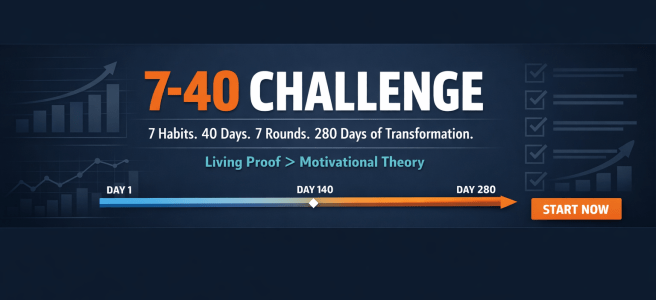
Day 48: Thank You Campaign — My Dad

Round 2, Day 8
Sunday, February 22, 2026

Welcome to Gratitude Sunday.

Every Sunday this year, I’m taking time to express how thankful I am for the people, the moments, and the things that have shaped my life. I call it the Thank You Campaign. And tonight’s post is about my dad.

My dad has been so many things to me over the course of my life, and I could go on for a while about all of them. But there’s one thing I want to highlight tonight: I want to love my wife the way my dad loves my mom.

I have witnessed it firsthand for as long as I can remember. He has been head over heels in love with my mother since they met in their twenties. Almost fifty years of marriage later, he still goes out of his way to make sure she’s taken care of and that she’s okay. That kind of love doesn’t just happen. It’s chosen, over and over, day after day. And I’ve had a front-row seat to it my entire life.

There are three ways this has shaped me that I want to share tonight.

He gave me security. Growing up, I never questioned whether our home was stable. I saw how my dad treated my mom. I saw them work through their problems. I saw them take care of things together. Their relationship was solid, and because of that, I felt safe. A kid who watches his parents love each other well doesn’t have to wonder if the ground beneath him is going to shift. That’s a gift I always appreciated and appreciate so much more now that I’m older.

He showed me what protection looks like. I have watched my dad defend my mother, and I am thankful for it. There are some things you just don’t do around my dad, and disrespecting my mother is at the top of the list. He didn’t just show me that their relationship mattered inside our home — he showed me that there are some people in this life you simply don’t get to mess with. For my dad, that is and always has been my mother.

He showed me what tireless love looks like. There have been times when my dad was burned to a crisp — tired, worn out, running on fumes. And he still went out of his way to love her and take care of her. Not because it was easy. Because that’s who he is. Love isn’t just the good days. It’s the days when you have nothing left and you give anyway.

Dad, if you’re reading these words, know that there are so many other reasons I’m thankful for you. But tonight I’m highlighting this one: I have watched you love my mother consistently, every single day of my life. It is one of the things I admire most about you. You showed me how to love my wife with that same kind of effort, that same kind of devotion.

I want to take care of my bride with the same heart you’ve shown Mom. That’s the standard you set. And I’m grateful for it.

Thank you, Dad.


Day 48 of 280. Gratitude Sunday — The Thank You Campaign.

Day 47: The War Inside Your Head

Round 2, Day 7
Saturday, February 21, 2026

There’s a war going on inside your head right now, and you probably don’t even know it.

Seth Godin, in his book Linchpin, calls one side the lizard brain. Steven Pressfield, in The War of Art, calls it the Resistance. It’s the part of your brain that exists for one purpose: to keep you safe. And it’s very, very good at its job.

The other side? The ancient Greeks called it the Daemon. The Romans called it the Genius. It’s the creative force inside you — the part that sees possibilities, generates ideas, and pushes you toward something greater than survival.

And these two are at war with each other every single day.

The Idea You Let Die

Have you ever had a really good idea? Something creative, something that could help people, maybe even a business concept that excited you? And then a voice in your head said, “Nah. That’s too risky. That’ll never work.”

So you let it go.

And then, a year or two later, you saw that exact idea out in the world — built by someone else. And you thought, “That was mine.”

Godin would say that was your Genius, getting strangled by your lizard brain. And it happens all the time. Not because we lack ideas. Not because we lack talent. But because our biology is wired to treat creativity as a threat.

Why We’re Wired This Way

Here’s the part that hit me. Godin points out that the lizard brain loves being told what to do. Following instructions feels safe. If someone hands you a rulebook — sit here, do this, move to the next step — your lizard brain relaxes. Threat neutralized. Everything is fine.

But if you’ve ever been fired from a job without ever having a bad performance review, you know that following instructions doesn’t guarantee safety. You can do everything you’re asked to do — take care of people, excel at your work, check every box — and still get let go. I’m a firm believer that people like this end up finding better jobs, but that’s a post for a different day. The point is: compliance is not security. The only set of instructions I’ve ever found that truly delivers on that promise is God’s Word. But when humans are running the show, the rulebook can change on you overnight.

So why do we cling to it? Because we were trained to.

Think about it. From the time we were children, we were conditioned: sit down, shut up, learn the lesson, do the homework, move to the next grade. Year after year after year. Over a decade of training that rewarded compliance and punished deviation.

Is it any wonder we struggle to engage with our Genius as adults? We’ve spent our entire lives being told that coloring inside the lines is the path to success. And then we hit thirty, forty, fifty years old and wonder why we can’t create anything.

We have years of conditioning to overcome. That’s not an excuse — it’s just the reality of the battlefield.

Give the Lizard Brain a Roadmap

Here’s where it gets practical, and this is where the 7-40 Challenge connects.

The lizard brain needs structure to feel safe. The Genius needs freedom to create. So what if you gave the lizard brain what it wants — a roadmap, a set of daily habits, a predictable rhythm — so that the Genius can do its work without triggering a full-scale panic?

That’s exactly what these seven daily habits do for me.

The Bible study grounds me. The exercise clears my head. The water and calories keep my body functioning. The reading fills the creative tank. And by the time I get to my creative hour, the lizard brain has been fed. It’s calm. It’s satisfied. And the Genius shows up.

In the last forty-seven days, the Genius has been showing up. If you read yesterday’s post, you know the list of what’s been accomplished. And today alone, I’m getting my first book uploaded to KDP and I outlined a full two-act musical that’s been rattling around in my head for four years. That’s not because I defeated the lizard brain. It’s because I gave it a structure it could trust, and then I created within that structure.

The Real Question

So it comes down to this: Is it worth it?

Is it worth it to engage your life, work out the steps, build the habits, and push through the Resistance? Or do you sit in the job you hate, accept somebody else’s direction, and spend your life as a member of the factory?

Gary Vaynerchuk said something that stuck with me: “If it was supposed to be easy, everyone would do it.” And that makes sense, because everything worth doing requires us to fight our natural desire to stay safe in order to succeed.

I choose succeeding. I choose making myself better and honoring God by doing the most with the talents He gave me. Because I refuse to be the servant in Jesus’s parable who buried his talent in the ground because he was afraid to use it. That servant didn’t get praised for playing it safe. He got cast away.

The lizard brain says bury the talent. The Genius says invest it. The choice is yours — every single day.

I know which one I’m choosing.


Day 47 of 280. Feed the lizard. Free the Genius.

Day 45: The Pain Is the Evidence

Round 2, Day 5
Thursday, February 19, 2026

I woke up this morning and my first thought was one word: OWWWW.

My legs are destroyed. My body is letting me know in no uncertain terms that yesterday happened. And you know what? Good. Because that soreness is a reminder that I did what I was supposed to do.

The Double Whammy

Here’s the context. I hadn’t lifted in three weeks because of a hand injury. And when I came back, I didn’t just pick up where I left off — I switched programs entirely. I went from an ABABAB workout rotation to an ABCABC split. Different exercises, different structure, different demands on my body.

It’s going to work much better long-term. I’m not overtaxing the same muscle groups. My workouts are more focused and don’t take quite as long. But the combination of three weeks off plus a brand-new program? That’s a double whammy. And my legs are paying the bill.

Sore, But Still Moving

Here’s what’s interesting. The soreness made me want to complain. But it didn’t make me want to skip anything.

I actually went on a walk this morning to recap a meeting via voice note, and it got me out of the office early enough to start working the soreness out. Movement is the best medicine for sore muscles. Not sitting still. Not waiting for it to pass. Getting up and moving through it.

There’s a lesson in that, and it goes way beyond the gym.

Soreness Is Not Just Physical

I was thinking the other day about moving back to Oklahoma last year. It was a good season — I got a new job, I was back in a familiar area, surrounded by people I knew. But learning the new role, adjusting to a new part of town, working on a new house — it was overwhelming. I was sore in every sense of the word.

But here’s the thing. Since I moved here in June of 2025, I’m down twenty-two pounds. I’ve written two books. I’ve started new social media channels. I’ve gotten a ton of work done on the house. I’ve launched the 7-40 Challenge and haven’t missed a day.

The season made me sore. But the season made me better.

That’s how growth works. It doesn’t announce itself with comfort. It announces itself with aches — with the evidence that something changed, that you pushed past where you were, that the old normal isn’t normal anymore.

What I’d Tell You on Day Three

If you’re early in a new habit — day three, day five, day ten — and you wake up hurting, whether that’s physical soreness or the mental exhaustion of doing something hard every single day, I want you to hear this:

Success is on the other side of the hard.

The pain is the evidence that you have challenged the norm. You’ve done the work. You’ve challenged the status quo of your own life. Your body, your mind, your circumstances — they’re all adjusting to the new version of you. And that adjustment hurts.

But it’s supposed to hurt. Soreness is not a warning to stop. It’s confirmation that you started.

So if you’re sore today — in your muscles, in your schedule, in your patience, in your faith — don’t quit. Move through it. Walk it out. Let the ache remind you that yesterday, you did something that mattered.

The pain is the evidence. Keep going.


Day 45 of 280. Sore means it’s working.

Day 43: The Factory Worker Inside You

Round 2, Day 3
Tuesday, February 17, 2026

I’m still working through Seth Godin’s Linchpin, and tonight I want to talk about something that might make you uncomfortable.

There’s a factory worker living inside you. And if you’re not careful, he’ll run the show.

The System That Built Us

Godin makes the case — and he wrote this back in 2010 — that the industrial revolution didn’t just build factories. It built an education system designed to feed them. Sit down. Follow instructions. Get good grades. Go to college. Get a job. Do what you’re told. Collect a paycheck.

The highest value of that system wasn’t innovation. It wasn’t creativity. It was compliance. The goal was to produce people who could do a job for a day’s wage and not have to think.

And for a long time, that system worked. For the factories, anyway.

But here’s the thing Godin saw coming sixteen years ago: that era is over. And if it was over in 2010, it is buried in 2026. The rise of AI, the speed of change in the marketplace, the sheer volume of information and tools available — all of it demands something the factory model never taught us.

Applied creativity.

The Moment You Start Phoning It In

I know the factory worker mindset from the inside. During my days working in an insurance office, I felt it pulling at me constantly. When your contribution doesn’t seem to matter, when you’re not making progress, when the environment is draining — it is incredibly easy to just phone it in. Go through the motions. Clock in, clock out, repeat.

I think we all have moments like that. Seasons where the path of least resistance is to stop caring and just do the minimum.

I started breaking out of it when I realized something simple but powerful: my level of effort actually moved the needle. When I brought energy and intention to my work, things changed. When I phoned it in, they didn’t. The results were directly connected to the investment.

That’s not a complicated idea. But it’s one most people ignore.

The Rogue in the Cubicle

Here’s what I’ve learned about myself over the years. I am a creative free spirit living in a corporate, data-ordered world. Those two things don’t always get along.

I have to turn on music to keep my brain engaged. I have to move. I have to conceptualize problems in different ways just to stay satisfied — not because I’m difficult, but because that’s how I’m wired. And honestly, that creative wiring is exactly what makes me good at what I do.

Because if we look at things the same way every time, we never solve problems. We just keep describing them. New solutions require new ideas, and new ideas come from people who refuse to think inside the factory lines.

That rebellious streak? It’s not a flaw. It’s the linchpin quality Godin is talking about.

AI and the New Frontier

This is even more real for me right now as I learn to work with AI tools. The way I see it, AI is the ultimate amplifier of applied creativity — but only if you know how to use it.

I’ve been learning how to iterate: ask questions, get feedback, supply my critiques, apply my business knowledge, layer in my creativity, get more feedback, and iterate again. The process works. But it only works if you bring something to the table.

And here’s what I’ve noticed: the quality of the answer depends entirely on the quality of the question. If you’re not clear about what you need, the tool won’t save you. You have to understand what you’re working with — the sophistication of the model, the way you communicate and express yourself — so that the response fits the context of what you’re actually trying to accomplish.

In other words, AI doesn’t replace thinking. It rewards it.

The factory workers of 2026 are the people who will ask a machine to do their thinking for them and accept whatever comes back. The linchpins are the ones who will use these tools to multiply what they already bring — their creativity, their experience, their judgment.

Which One Are You?

So tonight I’ll leave you with this.

Are you a factory worker or a linchpin? Are you phoning it in — going through the motions at work, at home, in your health, in your relationships? Are you following the old model: sit down, follow instructions, don’t make waves, collect your check?

Or is there a rogue inside you that knows you were built for more?

Because here’s the truth: in today’s world, nobody is coming to hand you a better life. The era of doing what you’re told and being rewarded for it is over. If you are not taking the initiative to drive your own success forward — to learn new tools, to think creatively, to bring something to the table that nobody else can — then you are falling behind. Right now. Today.

Not tomorrow. Not next quarter. Now.

The people who thrive in 2026 and beyond won’t be the ones who followed orders the best. They’ll be the ones who refused to stop thinking, refused to stop growing, and took ownership of where they’re headed.

So if you haven’t started, start now. Not when you’re ready. Not when conditions are perfect. Now.


Day 43 of 280. Be the linchpin.

Day 42: Everything Is Connected

Round 2, Day 2
Monday, February 16, 2026

I’ve been reading Linchpin by Seth Godin again, and it’s stirring things up. But tonight’s post isn’t about Linchpin. It’s about something that book keeps pointing me back to — a thought I’ve been carrying for years.

Everything is connected.

A Hospital Bed and a Fish Bone Diagram

In 2018, I was lying in a hospital bed going through chemotherapy for the second time. A 13-centimeter tumor. Four one-week hospital stays. I didn’t know how much damage the cancer had done. I didn’t know how long I had.

A few friends from work would come visit and keep me up on the projects we had going. And because I didn’t have a whole lot else to think about, I started processing — really processing — how our business workflows actually worked. Where data originated. How it matured through systems and the activities of people. How something that started at the beginning of a process was eventually consumed by somebody at the end who had no idea where it came from. It just magically appeared.

Lying there, I could see it like a fish bone diagram. One thread of data with dozens of offshoots — different teams, different efforts, different parts of the business process. And I could see how the busted processes, the workarounds, the bull crap people had to do just to keep things straight — it all became very apparent.

That clarity has stayed with me. As a data professional, I try to share it with anyone who will listen: if we understand the overall business workflow, we can pass out the pieces, identify the problem areas, and start making things better. That’s true in any business, any organization, anywhere people work together.

But here’s the thing. That principle doesn’t stop at the office door.

The Insurance Company

I actually made the connection about life being connected even before the hospital bed.

In the mid-2000s, I worked at an insurance company where I was miserable every day. The owner smoked four to six cigars a day ten feet from my desk. Profanity filled the air. Morale was rock bottom.

And I realized something that changed my trajectory: I couldn’t be angry at work and healthy at home. It invariably carried over. My frustration at the office became tension with my family, and that was not a sustainable position.

I had to start working on myself personally — not because I loved the job, but because I knew that everything was connected. If one part of my life was poisoned, the rest would suffer.

Fast-forward a few years. I was working on my master’s degree, thriving in an academic setting where I had previously been a mediocre student. And I realized the difference wasn’t intelligence. It was devotion to the process of getting better — and being the same engaged, enthusiastic person in my whole life, not just pieces of it.

When I stopped compartmentalizing, everything changed.

The Kobe Bryant Principle

I heard a story about Kobe Bryant that stuck with me. Kobe deliberately studied the referee’s handbook — every rule, every call, every technicality. Not because he wanted to argue calls. Because he wanted to master the environment he was operating in.

If he wanted a specific foul called, he knew what action to take. He knew how to get timeouts. He knew how to stop the clock. He used the rules of the game to his advantage — not by breaking them, but by understanding them so deeply that he could stretch them.

That’s what excellence looks like. It’s not just knowing the rules. It’s knowing how to apply them so you can accomplish what you need to accomplish while still taking care of the people around you.

Kobe demanded that kind of mastery from himself. And he rose above almost every player who’s ever played the game because of it.

The Real Question

Seth Godin wrote Linchpin in 2010, and he was already pointing out that the industrial age — where the highest value of the education system was producing factory workers who would do a job for a day’s wage and not have to think — was over. That we had entered an era of applied creativity.

That is even more true today. The market is changing. AI is reshaping everything. The people who will thrive are the ones who see the connections, who understand the whole system, who refuse to compartmentalize their lives into disconnected pieces.

So here’s what I’d say to you tonight.

If you feel like two separate people between work and home. If you feel like two separate people between groups of friends. If how you feel in your mind doesn’t match how you act on the outside — you need to have a frank conversation with yourself.

The way God created us is to be whole. Engaged and excellent in all the areas of our lives — not fragmented, not compartmentalized, not running different versions of ourselves depending on who’s watching.

Everything is connected. Your health affects your work. Your work affects your family. Your family affects your purpose. Your purpose affects everything.

The data taught me that in a hospital bed. Life has been confirming it ever since.


Day 42 of 280. Everything is connected.